Consent, Copyright and Permissions in Community Archives
A community archive is built on trust. Every photograph a family hands over, every video a member uploads, every story a narrator agrees to record depends on that person understanding that their material will be used the way they were told it would be. Consent isn't a form to file away after the fact. It's the foundation the whole collection stands on.
For museums, libraries, heritage organisations and community groups building digital archives, permission questions arise in several distinct moments, and each one carries its own risks if handled carelessly.
Before going further, it helps to separate four questions that are often grouped together under the word “consent”: who owns the physical item, who owns its copyright, what the archive has permission to do with it, and what lawful basis the organisation has for processing any personal data it contains. One agreement may address several of these questions, but they are not interchangeable.
Physical and digital item donations
When someone hands over a physical photograph, letter or object, or uploads a digital file directly, the organisation is usually taking on more than custodianship. It's often taking on rights.
A deed of gift can transfer ownership of the physical material and record any rights the donor owns and agrees to transfer or license. However, ownership of an object and ownership of copyright are separate. A donor cannot transfer copyright they do not hold, so the archive may still need to investigate who created the material and when.
The Society of American Archivists' guide to deeds of gift sets out what a properly drafted one should cover: identifying the donor, describing the materials, transferring legal ownership, establishing provisions for use, specifying ownership of intellectual property rights, and indicating what should happen to any unwanted material. Done well, this document clarifies what the archive owns, what it is permitted to do with the material, whether any intellectual property rights have been transferred or licensed, and whether the donor has placed restrictions on access or use.
The mistake many smaller organisations make is treating the deed of gift as boilerplate. A donor who hands over a box of family photographs might be perfectly happy for the archive to publish them online but very unhappy to see them turn up in a commercial print run or a paid licensing deal. Unless that distinction is captured explicitly at the point of donation, the archive is left guessing, or worse, assuming permission it doesn't actually have.
Donor
Hands over the item
Deed of gift
Signed at the point of donation
Splits into two separate questions
Ownership of the item
Transfers to the archive once the deed is signed, along with any rights the donor actually holds.
Copyright
A separate question. A donor cannot transfer copyright they don't hold, so this needs checking.
User-uploaded content
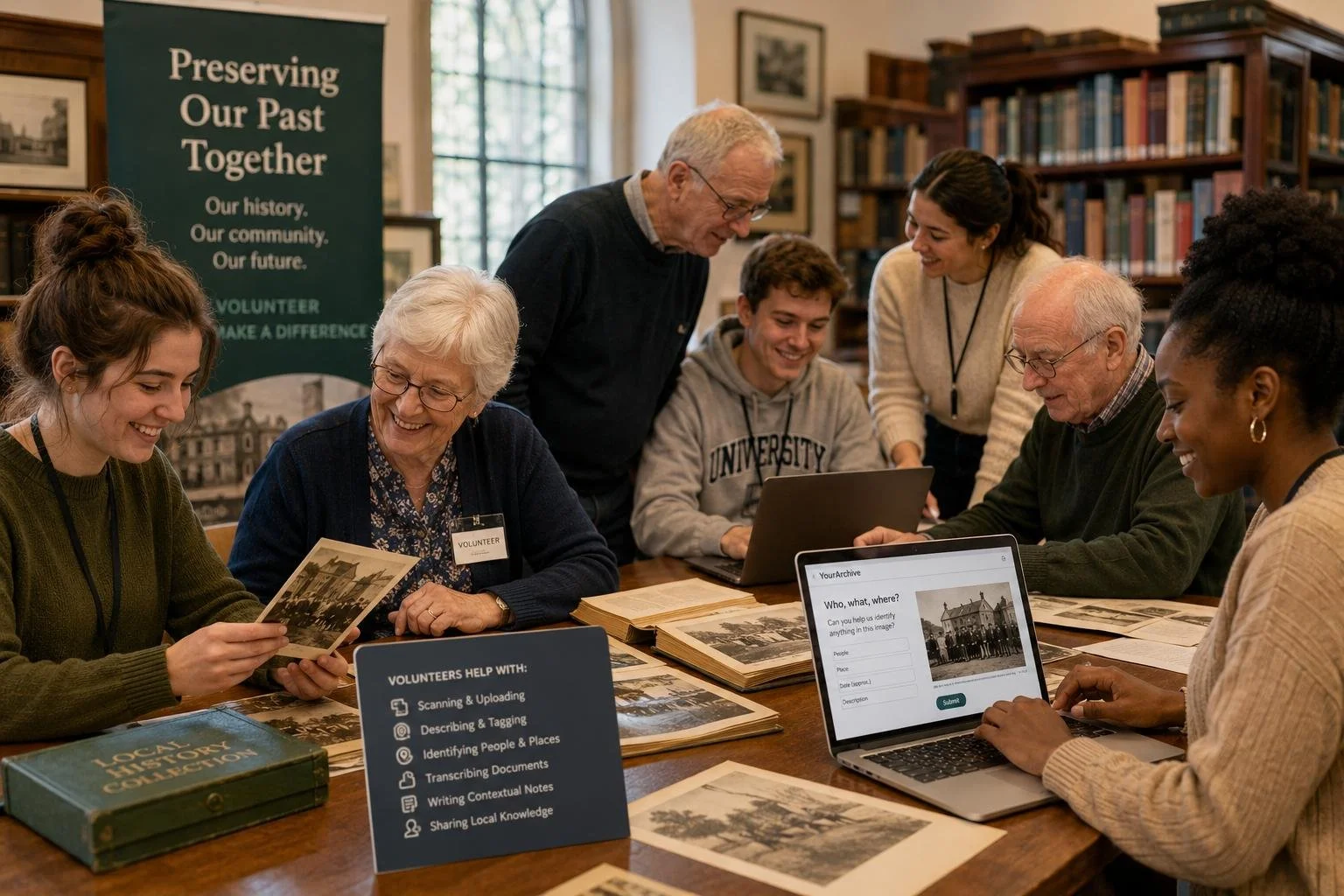
Community archives increasingly invite contributors to upload their own material directly through the platform they’re using to preserve, organise and share their community collections. This is one of the more valuable shifts in how archives grow. Material arrives already digitised, submitted directly by the person who holds it, at a scale no single archivist could match by scanning items one at a time. It also widens who gets to take part: any community member can upload content from anywhere in the world.
This kind of participatory contribution is well established as a way of growing archives, not just a workaround. Mia Ridge's widely referenced work on crowdsourcing in cultural heritage frames it as a genuinely mutual arrangement, one that benefits both the institution's collections and the audiences taking part, rather than simply outsourcing digitisation work.
But it creates a different consent problem to a formal donation, because the person uploading is often not thinking about terms the way a physical donor would. They're adding a photo in the moment, not signing a document.
Good practice treats the point of upload as the moment when the contributor is clearly told how their material may be stored, accessed and reused. That information should be visible and specific before the upload is completed, rather than buried in general terms and conditions.
Organisations must also identify an appropriate lawful basis for processing any personal data contained in the contribution. Consent is one possible lawful basis, but it will not necessarily be the right basis in every case. Where an organisation does rely on consent, the Information Commissioner's Office requires it to be specific and informed, with granular options where different purposes are involved. A vague or catch-all tick box is unlikely to be sufficient.
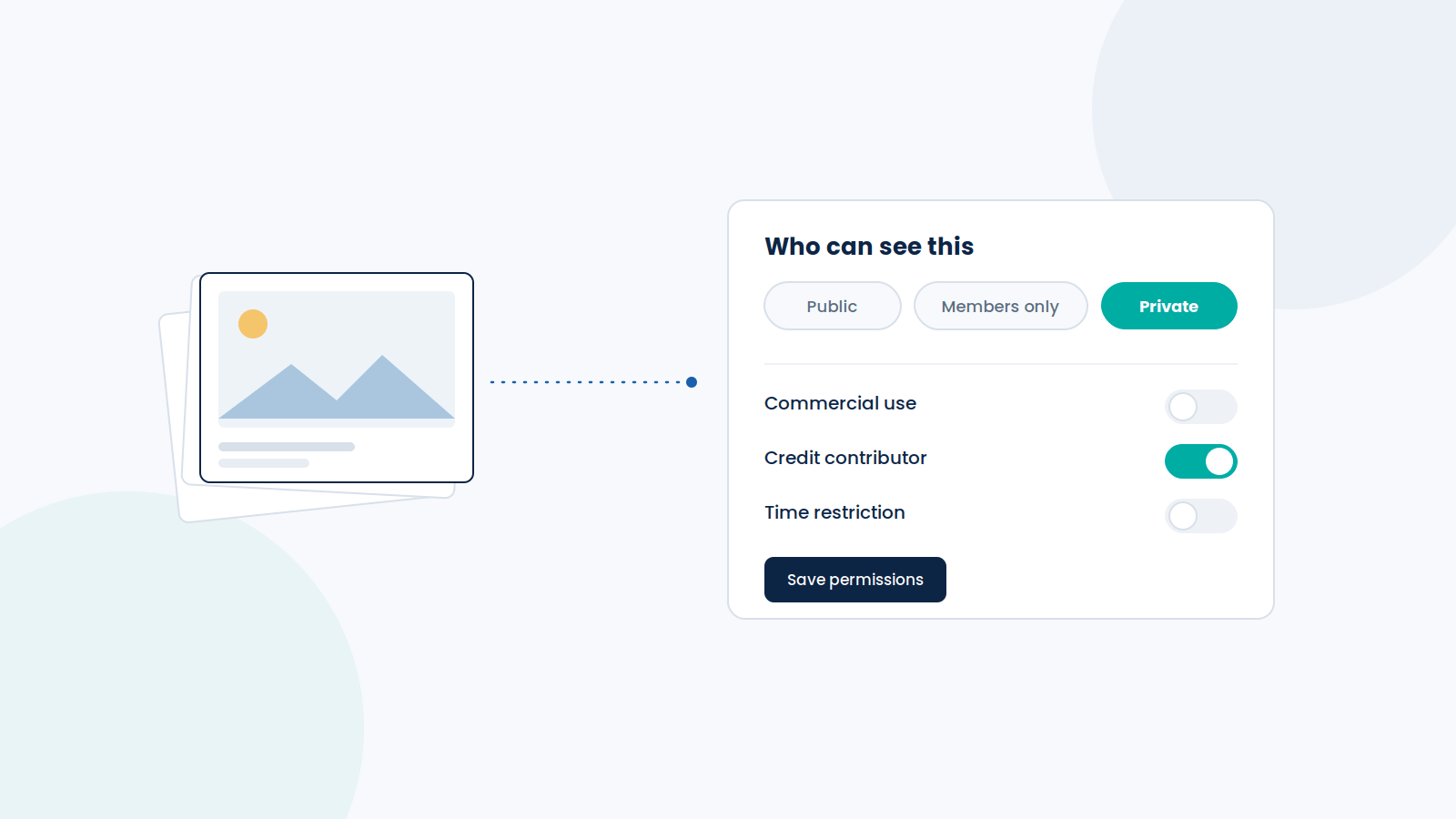
Applied to an upload form, this means that “can we use this?” may contain several separate questions. Will the material be visible to the public or only to members of the organisation? Can it be used in promotional materials? Can it be used commercially? Can the contributor be identified publicly? The answers should be captured clearly at the point of contribution.
Upload consent
One toggle isn't consent
"Can we use this?" needs breaking into questions a contributor can actually answer individually.
Can we use this?
Visible to the public
Used in promotional material
Used commercially
Contributor named publicly
Oral histories and spoken stories
Recorded interviews carry the most layered consent requirements of the three, because the archive is capturing a person's voice, likeness and personal narrative all at once, often on a sensitive or personal topic.
The Oral History Association's Statement on Ethics sets out the principle clearly: users of oral history material should analyse it in ways that stay true to the narrator's own words and meaning, and should avoid quoting out of context or distorting what was originally said. In the UK, the Oral History Society's legal and ethical guidance goes further, noting that no UK law was written specifically for oral history work, which is exactly why the sector has built its own voluntary ethical framework on top of the legal minimum.
In practice, this usually means a two-part process. Informed consent covers whether someone agreed to be interviewed and understood how the recording would be used. A separate release form or deed of gift then covers copyright and access rights, since the Montana State University oral history guide points out that informed consent and copyright are two different things, and one does not automatically cover the other. Some archives merge both into a single signed agreement; others keep them separate so a narrator can, for example, consent to being recorded while still restricting commercial use of the final recording.
Oral history consent
A two-part process
Informed consent and copyright are two different things, and one does not automatically cover the other.
Informed consent
Confirms the narrator agreed to be interviewed and understood how the recording would be used.
At the interview
Copyright and access rights
A release form or deed of gift setting out how the finished recording can be stored, published and reused.
Release form or deed of gift
These can be combined or kept separate. Some archives merge both into a single signed agreement. Others keep them apart, so a narrator can consent to being recorded while still restricting commercial use of the final recording.
Why "consent" isn't a single setting
The common thread across all three scenarios is that permission is not binary. A contributor rarely wants a simple yes or no. What they usually want is control over specific dimensions of use:
Audience. Public, members-only, or restricted to a named group such as family or a research team.
Commercial use. Whether the item can appear in ticketed events, merchandise, licensing deals or paid publications, as distinct from free public display.
Attribution. Whether the contributor's name is credited, kept anonymous, or displayed under a pseudonym.
Time. Some donors and narrators want an embargo, restricting access until a set future date or until they've passed away.
Withdrawal. Whether, and how, someone can later ask for their material to be removed or restricted.
Treating these as one setting, effectively "shared or not shared," is how organisations end up either over-restricting valuable material out of caution or, worse, using something in a way a contributor never agreed to.
Where Creative Commons licensing fits, and where it doesn't
Creative Commons licences are a natural reference point here, but they are designed for a slightly different purpose from the one many community archives need. Creative Commons licences can be used when an institution holds, or is authorised to exercise, the necessary copyright and wants to permit reuse under clearly defined terms. Many archives, however, hold items for which they are the custodian rather than the copyright holder. Ownership of the physical item does not automatically give the archive the right to license its use.
That's the gap RightsStatements.org was built to help address. Its rights statements allow cultural heritage institutions to communicate the copyright and reuse status of items in their collections. Unlike Creative Commons licences, these statements provide information about an item’s rights status rather than granting permission to reuse it.
For a community archive, the practical takeaway is this: a Creative Commons licence may be appropriate when the organisation owns or controls the relevant copyright and wants to actively permit reuse. A RightsStatements.org statement, or an equivalent plain-language rights label, may be more appropriate when the archive needs to communicate what is known about an item’s copyright status without granting rights it does not hold.
The legal backdrop
In the UK, data protection law adds a further layer whenever an item contains personal information about identifiable living people, whether that is a photograph, a name in a caption or a recorded voice. UK GDPR and the Data Protection Act 2018 recognise archiving in the public interest, but this is not a blanket exemption from data protection responsibilities. Organisations must still identify an appropriate lawful basis, be transparent about how personal data will be used and put appropriate safeguards in place.
The National Archives' guidance explains that exemptions may apply to qualifying archiving in the public interest, subject to specific conditions and safeguards. Depending on the content and context, this may mean restricting access to material containing personal data about living people. A well-designed permissions system should make it possible to apply those restrictions to individual items rather than unnecessarily limiting access to an entire collection.
A permissions checklist for every contribution
Before accepting an item or recording, establish:
Who owns the physical or digital item?
Who created it, and who is likely to own copyright?
Does it contain identifiable or sensitive personal information?
Where may it be displayed?
Who may access it?
Can it be reused in marketing, publications or commercial projects?
How should the contributor or creator be credited?
Are there any embargoes or time limits?
What happens if the contributor later requests a change?
Where will the agreement and subsequent changes be recorded?
How this looks inside YourArchive
Good permissions management depends on more than having the right form. The agreement also needs to remain connected to the item, so future users can see what was agreed without searching through spreadsheets, inboxes or paper files.
YourArchive is designed to support this at item level. Every item added to a collection, whether it is a formal donation processed by an archivist or material uploaded directly by a community member, can carry its own permission settings rather than relying on a single rule for the whole archive.
An organisation might make an exhibition gallery publicly accessible while limiting reunion photographs to registered members. A contributor uploading family material can permit public display while restricting commercial use, such as inclusion in merchandise, licensed reproductions or paid publications. Items can also be made visible only to a named group, allowing access to be managed according to the agreement made with the contributor.
Recorded oral histories, or Spoken Stories captured through the platform, can carry the same layered permissions. Informed consent can be captured at the point of recording, while separate settings control who can listen to the finished interview and how it may be reused. This enables an organisation to distinguish between consent to take part, permission to publish and permission for wider or commercial reuse.
By recording these decisions alongside each individual item, YourArchive gives organisations a clear and searchable record of what was agreed at the point of contribution. Permissions do not have to be managed through separate spreadsheets, paper forms or email threads that may be difficult to find months or years later. If access requirements change, the relevant item can be updated without unnecessarily restricting the rest of the collection.
The bottom line
Every community archive is a relationship with the people who trust it with their material. Getting permissions right, at the point of donation, at the point of upload, and at the point of interview, protects that relationship rather than getting in its way. The organisations that treat it as central rather than incidental are the ones whose collections keep growing, because contributors trust them enough to keep coming back.
Build trust into every contribution
See how YourArchive can help your organisation collect stories and material, record permissions and manage access at item level, all within one digital archive.
Book a demo to explore how it could work for your collection.
This article provides general guidance rather than legal advice. Organisations should seek specialist advice where rights ownership or the lawful use of personal data is unclear.
FAQs:
Do I need consent to display someone's photo in a community archive?
Not necessarily, but you do need to consider data protection, copyright and the context in which the photograph was taken. If a living person is identifiable, the image may constitute personal data and the archive must identify an appropriate lawful basis for publishing it. Consent is one possible basis, but it is not the only one. Sensitive images, photographs of children and material likely to cause distress require particular care.
What is a deed of gift, and do I need one for donated items?
A deed of gift is a written agreement that can transfer ownership of donated material and record any rights the donor agrees to transfer or license. Ownership of the material and ownership of its copyright are separate, and a donor cannot transfer copyright they do not hold. A properly drafted agreement identifies the donor, describes the material and records any conditions or restrictions on its access and use.
Can I use donated or uploaded photos for commercial purposes?
Only where the archive has the necessary rights or permission. The person granting permission must have the authority to do so, which cannot be assumed simply because they donated or uploaded the material. Public display and commercial reuse, such as merchandise, licensing or paid publications, should be addressed separately in the contribution agreement.
Is verbal consent enough for an oral history interview?
Verbal consent may be valid in some circumstances, but it can be difficult to evidence later. For that reason, good practice is to document informed consent and agree in writing how the recording may be stored, accessed, quoted, published and reused.
What's the difference between a Creative Commons licence and a rights statement?
A Creative Commons licence allows a copyright holder, or someone authorised to act on their behalf, to permit reuse under defined conditions. A RightsStatements.org statement does not grant permission. It communicates what an archive knows about an item’s copyright and reuse status, which is useful when the archive holds the material but does not control the copyright.
Can someone ask for their material to be removed from an archive after uploading it?
A contributor can always ask for material to be removed or restricted, but whether the archive is legally required to comply will depend on the agreement made when it was contributed, the archive’s lawful basis for processing personal data and whether any archival exemptions apply. Where an organisation relies on UK GDPR consent, withdrawing that consent must be as easy as giving it. Archives should explain their withdrawal process clearly before accepting a contribution.
Can I restrict who sees certain items in an online community archive?
Yes, this is one of the most useful controls a digital archive can offer. Items in YourArchive can be set to public, members-only, or visible to a named group, independently of the rest of the collection, so one sensitive donation doesn't force an entire archive to be more restricted than it needs to be.
Other articles that may be of interest: