How Searchable Is Your Archive? 10 Questions to Ask
LAST UPDATED: September 2026
Being digitised doesn't mean being discoverable. This article puts your archive to the test with 10 practical questions, covering full-text search, handwriting, photographs, audio and facial matching, and shows you where the hidden gaps in your collection are likely to be.
Digitising a collection is a milestone. Every organisation that has spent months scanning photographs, transferring old tapes or uploading documents deserves to feel proud of that work.
But digitised and discoverable are not the same thing.
A collection can contain extraordinary material and still make people work surprisingly hard to find it. If the only way to locate something is to already know which folder it sits in, which collection it belongs to or which volunteer catalogued it, then the material may be preserved digitally, but much of its value remains hidden.
The real test is what happens when someone who does not know your archive tries to use it.
Can they find a particular person? Search for a street or building? Discover everything relating to an event? Search the words inside a document or the voices contained in an oral history?
Good cataloguing is fundamental to making collections accessible and understandable. The National Archives provides extensive guidance on cataloguing practices and improving access to collections. But modern digital archives can take discoverability much further, using technologies such as Optical Character Recognition (OCR), transcription, metadata, tagging and facial matching to reveal information that would otherwise remain buried inside individual files.
So, how searchable is your archive really?
Here are 10 questions to put it to the test.
Can people find who and what they are looking for
1. Can you search for a subject across different types of material?
Choose something you know appears throughout your collection. It could be an annual carnival, a local football club, a regiment, a prominent family, a factory or an important moment in your organisation's history.
Now search for it.
Do you see photographs, programmes, newspaper cuttings, minutes, video, audio recordings and related documents together? Or do you need to know which individual collection or folder to search?
Historical stories rarely fit neatly into one format. A single event might be documented in a photograph, mentioned in a committee minute, described in an oral history and captured on film.
The more easily those individual records can be connected, the easier it becomes for researchers and community members to see the bigger story.
A single event rarely lives in a single format. The more easily a photograph, a minute book entry, a newspaper cutting, a recording and a film connect to the same search, the easier it becomes to see the bigger story.
2. Can you search by place name or address, not just a collection title?
Place is one of the most natural ways people explore local history.
Someone may want to know what their street looked like 70 years ago, research a building that no longer exists or find photographs of the pub their grandparents ran.
A folder called "Church Street 1960s" works if someone already knows that folder exists. But what about references to Church Street contained in other collections?
Useful metadata and tagging can connect records to streets, buildings, villages, venues and landmarks, allowing someone to search by place regardless of where an individual item happens to sit within the archive.
It also means a single search can begin to reveal change over time: the shop that became a bank, the factory that became housing or the community hall that has appeared in hundreds of photographs without anyone previously thinking to connect them.
3. Can you search by date or date range across the whole collection?
Imagine someone wants to know what was happening in your town, organisation or community in 1974.
Could they simply search 1974?
Could they broaden that to the 1970s? Could they narrow the results to a particular month or combine the date with a person, place or subject?
Dates are one of the simplest pieces of archive metadata, but their usefulness increases enormously when they work across the entire collection rather than within individual folders.
Not every record will have an exact date, of course. Historical collections are full of photographs labelled "probably late 1950s" or events remembered as "around 1982". A useful archive needs to accommodate that uncertainty rather than making an exact date a prerequisite for discovery.
Can people find words, not just files
4. Can you find a document by a phrase inside it, not just its title?
This is one of the easiest ways to expose the difference between storing digital files and creating a searchable digital archive.
Imagine a scanned committee report saved as:
Minutes_March_1976.pdf
Its filename tells us almost nothing about what happened at the meeting.
Perhaps the document mentions the closure of a local factory, the opening of a new clubhouse, a fundraising appeal and 15 people by name. Unless somebody has manually entered all of that information as metadata, those details can remain invisible to search.
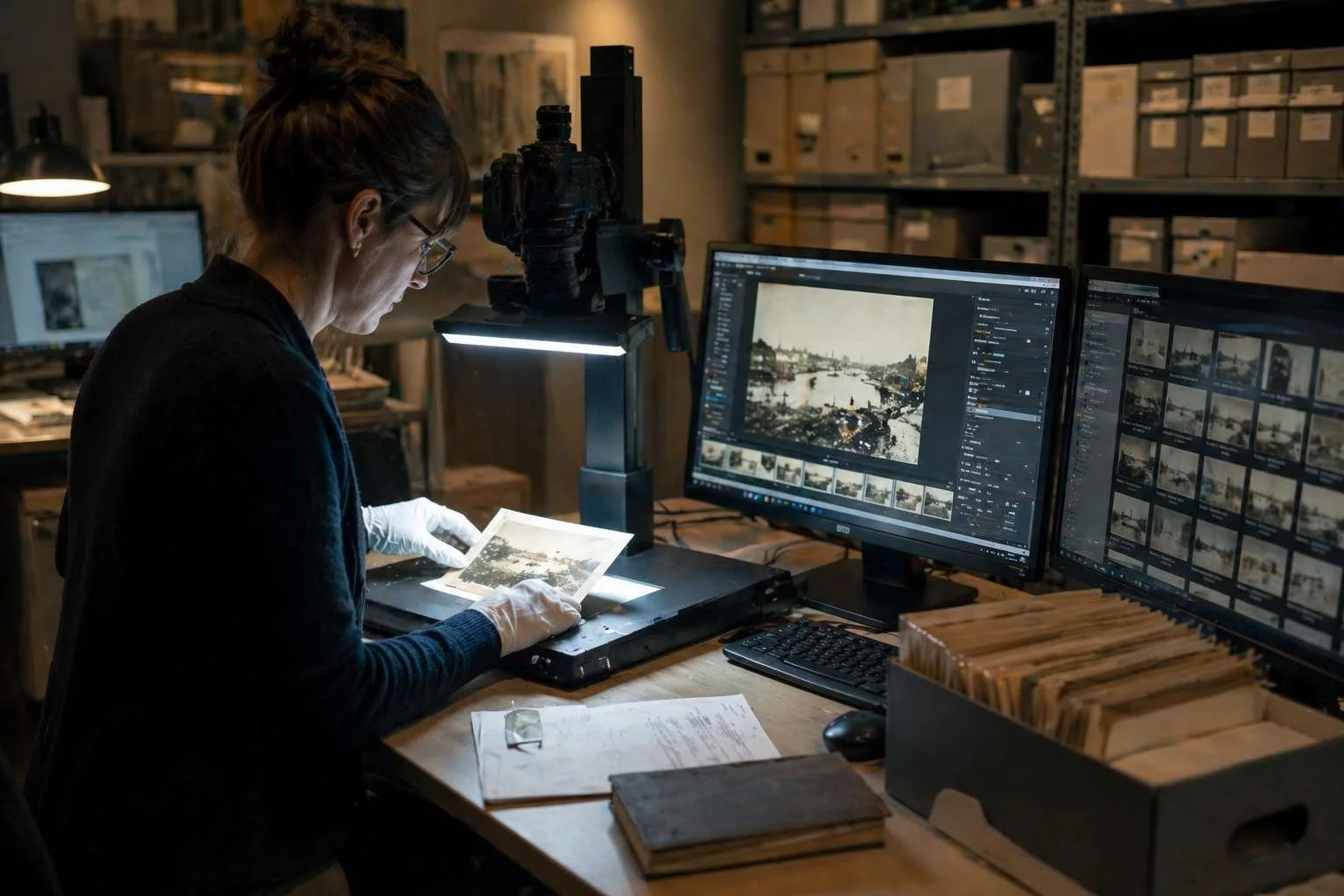
Optical Character Recognition (OCR) changes that by converting text within scanned documents into machine-readable text.
Instead of searching only filenames and catalogue descriptions, users can search the contents of the documents themselves.
For collections containing newsletters, programmes, minutes, newspaper cuttings, reports and other printed material, that can reveal thousands of previously hidden names, places, organisations and events.
5. What happens when the material is handwritten?
Printed documents are the easier case.
Community and heritage archives also contain letters, diaries, registers, minute books, annotations, postcards and handwritten notes. Often these records contain exactly the kind of personal detail that makes a collection valuable to local historians and family researchers.
Handwriting recognition technologies can increasingly turn handwritten material into machine-readable text, although results vary considerably depending on the handwriting, language, layout, age and condition of the original.
Human review can therefore remain important.
The aim does not have to be a perfect transcription of every page. Even making previously inaccessible names, dates or phrases discoverable can provide researchers with new routes into a collection.
6. Can you find words that appear inside a photograph?
Documents are not the only archive items containing text.
Look closely at an old street photograph and you might see shop signs, road names, advertisements, vehicle lettering, banners, posters or notices.
Those words may provide important clues about where and when a photograph was taken, yet none of them necessarily appear in its caption.
Image text recognition can make some of that information searchable too.
Imagine a photograph of a street party in 1953. Nobody recorded the exact location, but the name of a pub is visible in the background. Identifying that text could provide the clue that connects the image to a particular street, event or community.
The information was always there. Search technology simply gives us another way to uncover it.
7. Can you search the words spoken inside an audio or video recording?
Oral histories can be among the richest records in an archive and among the hardest to search.
A two-hour interview might contain dozens of names, places, businesses, events and personal memories. Traditionally, finding one particular reference meant somebody had to know it was there or listen through the recording until they reached it.
Automatic transcription changes that.
When speech is converted into searchable, timestamped text, someone researching a particular factory, street, person or event can search the transcript and jump to the relevant part of the recording.
That makes audio and video much easier to explore while preserving something a written summary cannot: the person's actual voice.
This is one of the ideas behind Spoken Stories, which helps organisations capture recorded memories alongside searchable transcriptions so that oral history and other recordings become part of the wider archive rather than an isolated audio or video file.
OCR, handwriting recognition, image text recognition and transcription all do the same essential thing: turn words nobody typed into metadata into words anyone can search.
Can the archive help uncover what nobody has catalogued yet
8. Can you find photographs of a person even when nobody captioned them?
Photographic collections present a particular problem.
You may have hundreds of photographs containing the same individual but only a handful where that person has actually been identified.
Facial matching technology can help identify likely appearances of the same person across a collection. Once a face has been identified, those matches can reveal other photographs that may never have been captioned or catalogued with that person's name.
Human verification still matters, particularly with older images, changes in appearance over time, large group photographs or poor-quality originals.
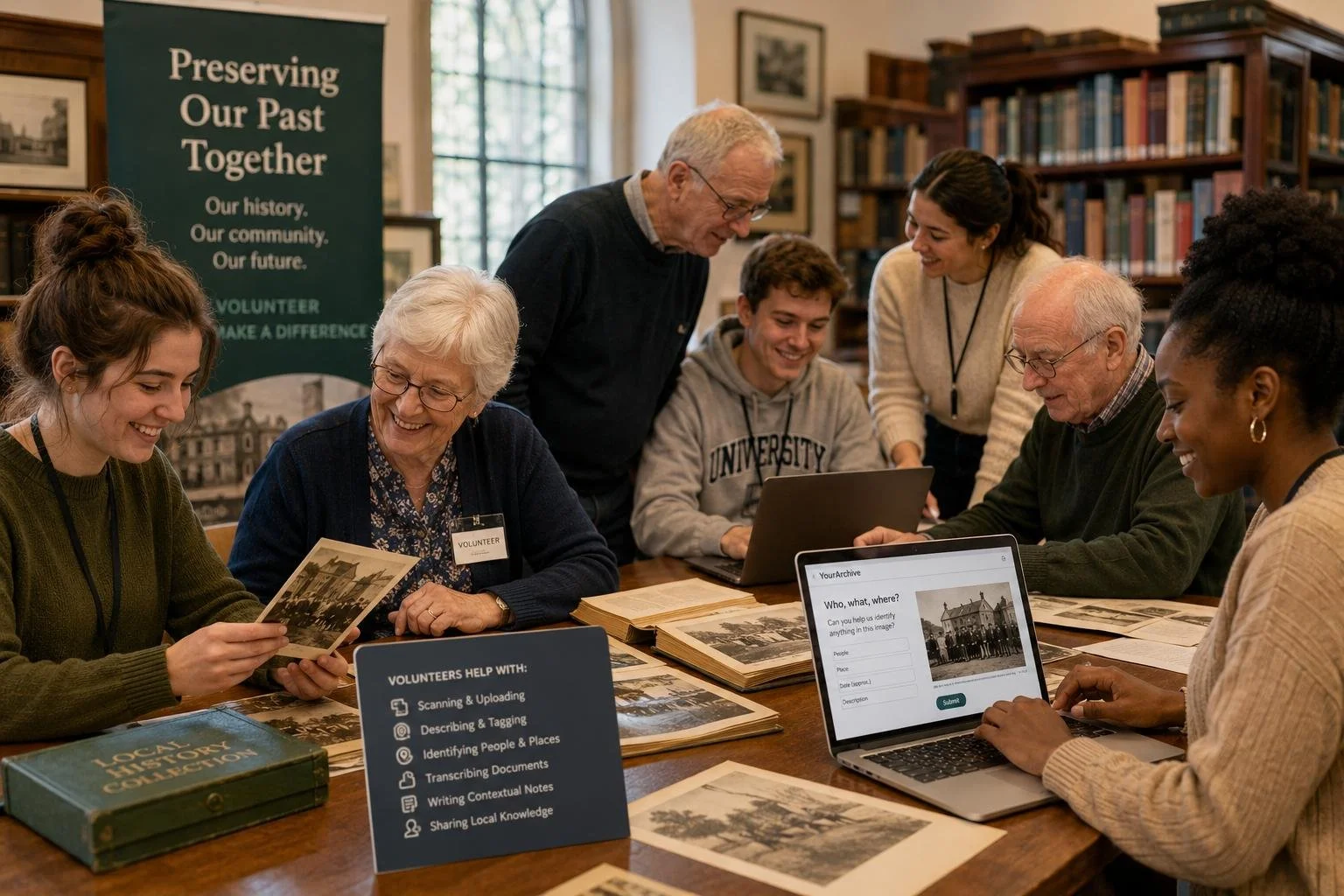
That is also where community knowledge becomes incredibly valuable.
A former member, long-serving volunteer or local resident may recognise someone an archivist never could. Once that knowledge is captured as part of the record, it becomes available to future users rather than remaining in one person's memory.
9. Can someone unfamiliar with your filing structure still find the right item?
This may be the most revealing test of all.
Ask someone who did not build your archive to find something.
Do not tell them which folder to open, what terminology the cataloguer used or which collection the material belongs to. Give them a person, place, event or subject and see what happens.
Good metadata helps each item carry useful information beyond its filename: who or what it depicts, when and where it was created, what it relates to and how it connects to the wider collection.
Consistency matters too.
If one person records a location as "St Mary's Church", another as "St Marys" and another simply as "the church", searchability can quickly suffer.
This is why metadata and cataloguing are not simply administrative jobs that happen behind the scenes. They directly influence what users can discover.
It is also why discoverability should be considered when deciding what to digitise first. A historically important collection that nobody can successfully search risks remaining underused even after considerable time has been spent digitising it.
10. Does your archive become more searchable as people use it?
The best digital archives are not static catalogues…
Someone recognises a face in an unidentified photograph.
A former resident corrects the name of a street.
A club member remembers the year an event took place.
A volunteer discovers that two records previously catalogued separately relate to the same person.
A researcher adds context nobody had previously recorded.
The question is: what happens to that knowledge?
If it disappears when the visitor closes their browser or remains in an email sitting in someone's inbox, the archive has gained very little.
If corrections, identifications, tags and contextual information can be reviewed and incorporated into the collection, however, the archive becomes richer and more searchable over time. This is particularly important for community archives because no single cataloguer can know everything contained within them. The knowledge is distributed throughout the community.
A truly discoverable archive creates ways to capture it.
Why archive searchability matters
An archive that only its cataloguer can navigate is, in practical terms, accessible to a very small audience. Searchability opens collections to people who approach them from entirely different directions,.
A family historian might begin with a surname.
A former resident might search for a street.
A researcher might search for an organisation or industry.
A club member might look for a particular team or season.
Someone else may simply remember a fragment: a pub name, an event, a teacher or a phrase from an old newsletter.
They should not need to understand your cataloguing system before they can begin. That is ultimately what archive discoverability is about: reducing the amount somebody needs to know before they can find something.
And the easier it becomes to discover what an archive contains, the greater the opportunity for that material to be researched, shared, enriched and enjoyed.
How searchable is your archive? Score your collection
Go back through the ten questions and count how many you could confidently answer yes to.
Tick the ones you can confidently do today.
Difficult to discover 5–7
Good foundations 8–10
Highly discoverable
Tick a few boxes to see where your archive sits.
8–10: Highly discoverable
Your archive is doing much more than storing digital files. People can approach the collection from different directions and still reach relevant material. Your next opportunity may be enrichment: capturing more context, encouraging community contributions and creating new connections between existing records.
5–7: Good foundations, but some hidden material
You have many of the building blocks in place, but parts of the collection may still be difficult to discover. Look at which questions produced a "no". Are your documents searchable but your photographs aren't? Is metadata strong but audio and video effectively invisible? Those gaps give you a useful starting point.
0–4: Digitised, but difficult to discover
Your collection may be safely digitised, but much of its value still depends on somebody knowing where to look.
That does not mean starting again. Existing digital collections can be enriched with better metadata, OCR, transcription, tagging, facial matching and other tools that make the information already contained within them easier to discover.
YourArchive helps heritage organisations, museums, libraries, community groups, clubs and societies turn digitised collections into searchable, accessible digital archives, bringing together photographs, documents, audio, video and the knowledge that gives them meaning.
If this test revealed gaps in your own collection, get in touch to explore how YourArchive could make more of it discoverable, or book a short demo to see how it works in practice.
FAQs:
What is the difference between a digitised archive and a searchable archive?
A digitised archive contains material that has been scanned, converted or created in digital form. A searchable archive goes further, making the information within those files discoverable. Users should be able to find relevant people, places, dates, events or words without already knowing which folder, file or collection to search.
What is OCR and why does it matter for archives?
Optical Character Recognition (OCR) converts text within scanned documents and images into machine-readable text that can be searched. Without OCR, a scanned document may only be discoverable through its filename, catalogue description or metadata, even if it contains valuable names, places and other information.
Can handwritten documents be made searchable?
Yes. Handwriting recognition technology can make handwritten letters, ledgers, registers, diaries and notes searchable, although accuracy varies depending on the handwriting, document layout, language, age and condition of the original. Human review can still be important for checking and correcting results.
How does facial recognition help archives become more discoverable?
Facial matching technology can identify likely appearances of the same person across photographic collections, helping to surface images that were never captioned or catalogued with that person's name. Archivists and community members can then review potential matches and add verified identities and context to the archive.
How can organisations tell if their archive is discoverable enough?
A simple test is to ask someone unfamiliar with the collection to find a specific person, place, date, event or phrase without guidance. If they need to know which folder to open, how the collection was catalogued or the exact filename, there may be opportunities to improve discoverability through metadata, OCR, transcription, tagging or other search technologies.
Other articles that may be of interest: