Centenary Celebration Ideas for Charities and Nonprofits
LAST UPDATED: May 2026
Summary: A centenary is more than a celebration. It is a rare opportunity to reconnect communities, capture disappearing stories and create a lasting legacy. This article explores meaningful centenary celebration ideas for charities and nonprofits, from oral histories and digital time capsules to supporter storytelling campaigns and digital archives that continue growing long after the anniversary year ends.
What makes a centenary worth celebrating
A hundredth anniversary is not like other milestones. It carries a weight that a tenth or even a fiftieth anniversary rarely does. It means the organisation has served multiple generations of the same communities, in many cases multiple generations of the same families. It means the founding mission has survived decades of change, financial pressure, shifting political priorities and the steady turnover of the people who carried the work forward.
For charities and nonprofits, a centenary is one of the few moments that unlock genuine public trust in a way no marketing campaign can manufacture. It is proof of longevity, and longevity is proof of purpose.
A centenary only happens once. But the stories surfaced during it can shape the next hundred years.
There is also a practical dimension that many organisations underestimate. Milestone anniversaries create permission to reach people who have drifted. Former volunteers get in touch. Ex-staff members resurface. Long-term beneficiaries who lost contact respond to anniversary campaigns when they would not respond to a standard fundraising appeal.
For many organisations, centenary years also become some of the strongest supporter engagement and donor stewardship opportunities they will ever have. People who attended an early service remember something they have never told anyone. A centenary gives an entire community a reason to come forward, and that window does not stay open for long.
The question is what happens to what they bring.
The strongest anniversary and milestone events are the ones that turn this temporary surge of memory, contribution and attention into something permanent.
100 years of memory, contribution and legacy
Past
Photographs, records, memories and stories that explain where the organisation came from.
Present
Volunteers, supporters, staff and community members contributing what they remember now.
Future
A searchable archive and digital legacy that continues to grow beyond the anniversary year.
How organisational memory disappears: the risk every charity faces at 100
Most organisations approaching their hundredth year believe their history is better preserved than it actually is. The assumption is that because records exist somewhere, they are accessible. Because photographs were taken, they are safe. Because the stories are known to the people who were there, they are not yet lost.
Organisational memory disappears slowly and then suddenly. Consider how quickly each of these becomes permanent:
The trustee who joined in 1978 and remembers the capital campaign that nearly ollapsed retires, and the story goes with them
The founding volunteer who knew every early beneficiary by name passes away, and decades of context are gone overnight
The unlabelled box of photographs in the storeroom gets thrown out in an office move
The early Facebook page falls dormant, gets deleted, or becomes inaccessible.
The local newspaper archive that documented thirty years of the organisation's work is paywalled, poorly digitised, or simply lost
The long-serving programme manager who carried the institutional knowledge of how services actually operated leaves, and no handover document comes close to capturing what she knew.
Many charities approaching their centenary discover, when they actually begin to look, that their institutional memory is far thinner than they believed. The period of the 1970s and 1980s exists only in the recollections of people in their sixties and seventies. The founding decade is a gap.
A centenary creates urgency because the people who hold the oldest memories are, by definition, getting older. The window to capture what they know is not indefinite. The organisations that treat a centenary as a preservation project as well as a celebration are the ones that come out of their hundredth year with something that will genuinely matter in another hundred years.
How Thrive is building a centenary archive for the next 100 years
Thrive, a charity based in Somerset, UK, with a century of service to communities across the county, is building its centenary time capsule using YourArchive. Their approach illustrates clearly what it looks like when an organisation uses a milestone year to create something lasting rather than something commemorative.
The archive is organised around two distinct purposes: looking back at where the organisation has come from and looking forward to the communities it will serve in the future.
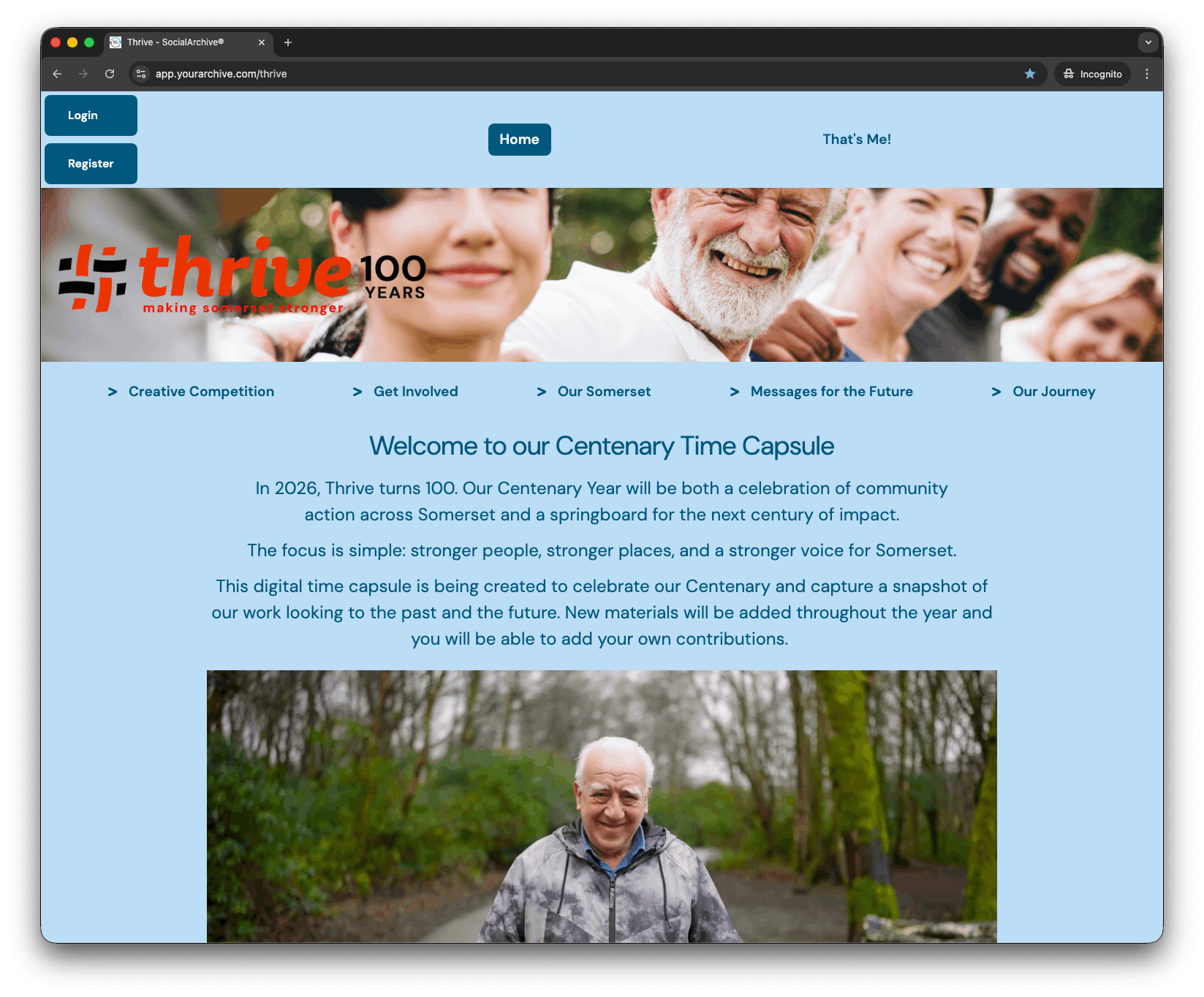
The retrospective layer includes a timeline of key organisational milestones across previous decades, alongside historical images, press clippings and archival material that documents the shape of Thrive's work over a century. The intention is to capture not just the headline milestones but the contextual knowledge behind them: the community conditions, the people involved, the decisions that shaped the organisation's direction at critical moments.
The forward-looking layer is structured as an active community contribution project. Under the theme "Somerset Past, Present and Future," the archive invites people to submit photographs, written stories and video contributions, categorised to keep the growing collection navigable. A youth strand gathers artwork, poetry and predictions from younger generations. Whilst a "Messages to the Future" video wall invites contributors to record short messages built around themes of hope, change and belonging.
One of the more thoughtful structural decisions in Thrive's project is the separation of two distinct contributor channels: one for community memories and historical material looking back, and a separate space for messages directed specifically at future generations looking forward. YourArchive supports this through independent contributor areas, allowing each strand to be surfaced and searched independently while remaining part of the same overarching archive.
The project also takes seriously the question of what happens after the centenary year ends. It includes a clear explanation of how the digital time capsule will be preserved and made available to future audiences, and recognition for every contributor. The archive is designed to keep growing, not to close when the anniversary events conclude.
Thrive's project is the difference between marking a centenary and preserving one.
How charities lose their organisational history (and how to prevent it)
Preserving organisational history during a centenary is not simply a matter of digitising old photographs. It requires actively reaching the people who carry knowledge that exists nowhere in writing, before that window closes.
The most effective approaches combine formal archiving with community participation. The centenary year provides the motivation for both: people come forward during anniversary years with material they would not otherwise think to share, because the milestone makes the act of sharing feel meaningful.
Meaningful centenary celebration ideas that create a lasting legacy
The following approaches all share one characteristic: they produce something that outlasts the anniversary year. The most effective charity centenary projects combine several.
Oral history projects: capturing volunteer and community voices
Oral history is the most irreplaceable thing a charity can produce during a centenary year, because it captures what no document records: the experience, the context and the meaning behind the organisation's history, with a snapshot of the voices of the people who have lived it.
This means reaching beyond senior trustees and polished spokesperson interviews. The most valuable oral histories come from people whose stories have never been formally told:
Long-serving volunteers who remember the organisation before it had a proper office, or a proper budget
Beneficiaries who first accessed services decades ago and have never spoken publicly about what the support meant to them
Former staff who managed the organisation through a funding crisis, a merger, or a difficult period of change
Community members who remember what the organisation's founding work looked like on the ground
Oral history projects work best when they are designed for accessibility. Contributions do not need to be filmed in a studio. Many platforms, such as YourArchive’s Spoken Stories, allow contributors to record and submit audio or video remotely, guided by prompted questions. The prompts matter enormously. Open questions like "tell us about your time with the organisation" tend to produce short, self-conscious responses. Specific, evocative prompts produce far richer material:
"What o you remember about your first week?"
"Was there a moment when you understood what the work was really for?"
"What would you want people in fifty years to know about this period?"
"What has changed most? What has stayed exactly the same?"
The resulting collection of voice and testimony becomes one of the most irreplaceable assets the centenary can produce. It is also the part most at risk of not being captured at all, if the organisation treats the anniversary as primarily an events programme.
For organisations planning a centenary oral history project, we have also written a practical guide on how to capture oral histories from volunteers, supporters and community members using simple, accessible workflows.
Community story-sharing campaigns for charity anniversaries
A story-sharing campaign widens the contributor base beyond those with a direct personal history with the organisation, inviting the whole community to participate in building the archive.
Contributors might share:
Photographs from community events, services or locations associated with the organisation's work
Written memories of how the organisation was part of their life or community
Video messages reflecting on what the charity has meant to them or to people they know
Artwork, creative writing or responses from younger generations who have grown up with the organisation's work as part of their community
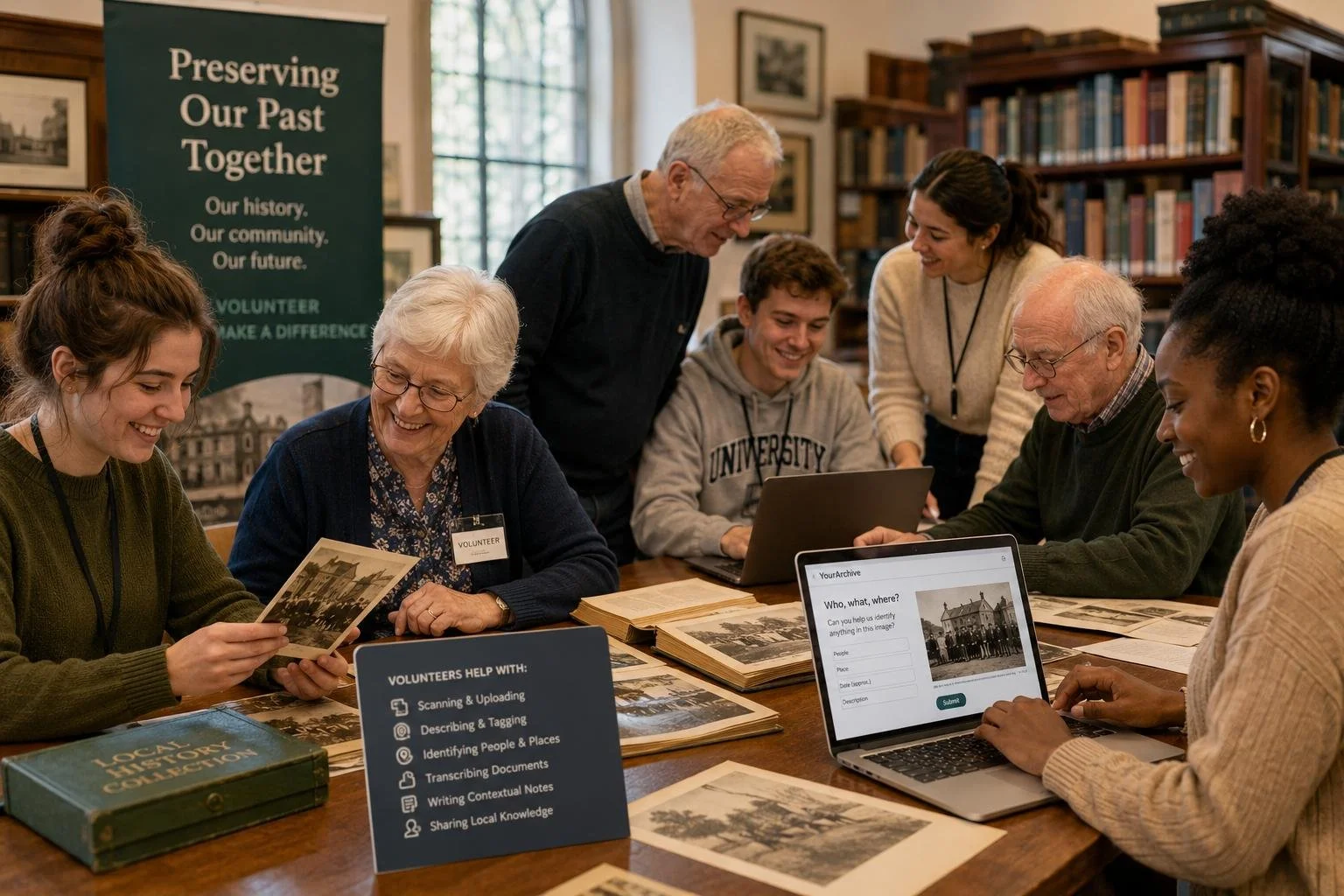
The most important design principle for a community story-sharing campaign is that contribution should feel easy and worthwhile. A clear, well-signposted submission process, with a visible home where contributions are published and searchable, makes the difference between a project that receives a handful of responses and one that generates sustained community engagement throughout the anniversary year.
The best community story-sharing projects are also designed to keep receiving contributions after the centenary year ends. Over time, these growing collections can help strengthen long-term community connection, giving people an ongoing sense of participation and ownership in the organisation's story. The anniversary is the launch of the archive, not its conclusion.
How nonprofits can celebrate a 100 year anniversary meaningfully with digital time capsules
A digital time capsule is one of the most powerful centenary celebration ideas available to charities and nonprofits, because it makes the present moment itself a deliberate act of preservation. Rather than only looking backwards at a hundred years of history, the organisation creates a record of the community as it is now, to be discovered and opened by a future generation.
What makes a charity digital time capsule distinctive is the act of contribution. When someone records a video message to be opened in twenty-five years, or writes a letter addressed specifically to the person who will read it in 2075, something shifts in how they engage with the organisation. They think about continuity. They think about purpose. They become participants in the story rather than an audience for it.
A well-designed charity digital time capsule might include:
Video messages from current volunteers, staff and beneficiaries, recorded as direct addresses to future generations
Photographs and written reflections documenting what the organisation's services look ike today
Youth contributions: predictions, artwork, creative writing and questions from young people imagining the world their grandchildren will inherit
Trustee and leadership reflections on the challenges and opportunities of the present moment
Questions posed directly to the people who will open the capsule: "What does the community look like now? Is the problem we were founded to address still there? What do you wish we had known?"
The submission process matters as much as the content. A digital time capsule that accepts contributions through a clear, guided online process, with prompted questions to help people structure their responses, will produce far richer material than one that asks for open-ended submissions. YourArchive is designed to support exactly this kind of structured, prompted contribution, allowing organisations to create separate submission channels for different types of content and making the growing collection searchable and well-organised from the outset.
The planned re-opening is also part of the value. A time capsule with a specific future date for its opening, communicated clearly to contributors and to the public, gives the archive an ongoing significance. The centenary year creates the archive; the opening date gives it a future.
A time capsule with a specific opening date gives the archive an ongoing significance. The centenary year creates it. Staged reveals keep the anticipation alive.
Flexible by design
Plan a single opening date, or schedule staged annual reveals. What works for your organisation and your community is what matters.
Sustained anticipation
Each reveal becomes a moment of community engagement in its own right, keeping the archive alive long after the centenary year ends.
Then-and-now storytelling: making 100 years of history visible
Visual comparison is one of the most accessible formats for centenary content, and one of the strongest generators of further community contribution.
Then-and-now storytelling pairs historical material with present-day equivalents: the same community event photographed sixty years apart, a founding location then and now, the faces of the volunteers in 1960 alongside their counterparts today. The format makes abstract claims about continuity concrete and visible. Saying an organisation has served a community for a hundred years is a statement. Showing it is evidence.
Then-and-now content is highly shareable, performs well on social media and in community settings, and tends to prompt people to come forward with their own archival material.
Interactive digital archives for nonprofit centenary celebrations
Most anniversary projects are designed around a single anniversary year. The events end, the microsite goes quiet, the commemorative booklet gets filed. The material gathered during the centenary exists but it is not searchable, not growing and not connected to the organisation's ongoing work.
A living digital archive takes a different approach. Rather than building a project that concludes with the anniversary year, it creates a permanent, searchable home for the organisation's history and community contributions, designed to keep receiving and organising new material over time.
For a charity approaching its centenary, an interactive digital archive means:
Historical material that is findable and navigable, not locked in a PDF or buried in a folder
Community contributions that are published and searchable, giving contributors a visible stake in the archive
A platform that connects the material gathered during the anniversary year to the organisation's ongoing community engagement
A resource that future staff, volunteers, historians and community members can actually use
Platforms, designed specifically for community contribution and long-term preservation make this dramatically easier. Rather than relying on scattered submissions, shared drives and temporary campaign websites, organisations can create a structured, searchable archive designed to grow alongside the community itself.
This is where the centenary becomes an investment in the next hundred years, rather than a retrospective on the last.
Why participation is the most important thing a charity centenary campaign can deliver
When organisations plan a major anniversary, the natural focus is on production: the photography, the booklet, the event design, the film. Production quality has its place. A well-made retrospective documentary creates a genuine historical record. A beautifully designed commemorative publication can be something people keep.
The thing that sustains community connection long after the anniversary year is not the quality of the production. It is the breadth of participation. A centenary project that involves five hundred people in contributing their stories, their photographs and their memories will generate more lasting loyalty than one that produces a beautiful object that people receive passively.
People support what they feel part of. An organisation that invites its community to be co-authors of its centenary story, rather than an audience for it, builds a relationship that a campaign budget cannot replicate. The contributors become stakeholders. They talk about the archive. They return to it. They bring others to it. They feel, in a way that is difficult to manufacture any other way, that the organisation belongs to them.
The most effective charity centenary projects are not produced for communities.
They are produced alongside them.
How to plan a charity centenary campaign that creates a lasting legacy
Before committing to any centenary project, it is worth asking a single question: what will exist in five years that would not have existed without this?
A gala dinner creates warmth and connection and genuine celebration. In five years, it exists in memory and perhaps in a handful of social media photographs. A commemorative booklet may survive on a shelf. A microsite will, in most cases, have been taken down or allowed to become outdated.
A well-built digital archive still exists in five years. It has probably grown. The voices recorded during the centenary year are still audible. The community contributions made during the anniversary are still searchable. Future staff, researchers and community members can find and use what was created – and continue to add to the archive over time.
Planning a centenary campaign that creates a lasting legacy means building the archive alongside the events programme, not as an afterthought. It means treating community contribution as a strategic priority rather than a nice-to-have. It means creating a submission process that makes it genuinely easy for people to share what they know, from wherever they are, at whatever stage of the anniversary year they find themselves ready to contribute.
The event is the permission. The archive is the legacy.
The real value of a centenary is not the event itself. It is the opportunity to capture what would otherwise disappear.
YourArchive helps charities, nonprofits and community organisations capture, organise and preserve the stories that matter most. From oral history collection and digital time capsules to searchable community archives and guided contributor submissions, YourArchive is designed to help organisations turn milestone anniversaries into lasting community resources.
Whether you are planning a centenary celebration, building an organisational archive, or creating a long-term storytelling project for future generations, YourArchive provides the infrastructure to collect and preserve community memory in one secure, searchable place.
Explore how YourArchive can support your centenary project by booking a short demonstration today.
FAQs:
What are good centenary celebration ideas for charities?
The most meaningful centenary celebration ideas for charities create something lasting rather than something commemorative. Oral history projects, community story-sharing campaigns, digital time capsules and interactive digital archives all produce material that outlasts the anniversary year. The most effective charity centenary projects treat the milestone as a community memory project: they involve supporters, volunteers and beneficiaries as active contributors, and they build a searchable archive that continues growing after the centenary year ends.
How can nonprofits celebrate a 100 year anniversary meaningfully?
Meaningful 100 year anniversary celebrations for nonprofits combine commemoration with active preservation. The anniversary year is one of the only moments when people with long memories of the organisation come forward unprompted: former volunteers, long-term beneficiaries, retired staff. Using that window to systematically capture oral histories, community stories and archival material produces something that benefits the organisation's future, not just its anniversary year.
How do charities preserve their organisational history?
Charities preserve their organisational history most effectively by combining formal archiving with active community participation. This means digitising historical documents and photographs, capturing oral histories from people with direct memories of the organisation's past, inviting community contributions of photographs and stories, and building a searchable digital archive that is accessible over the long term. Centenary years are a particularly valuable window because the anniversary itself motivates people to come forward with material they would not otherwise share.
What is a charity digital time capsule?
A charity digital time capsule is a structured collection of contributions from current volunteers, staff, beneficiaries and community members, recorded during an anniversary year and designed to be discovered and opened by a future generation. Contributors might submit video messages, written reflections, photographs, artwork or predictions. Unlike a physical time capsule, a digital version can accept contributions from anyone, anywhere, through an online submission process, and can be designed with a specific future opening date to give the archive ongoing significance.
How can charities collect oral histories from volunteers and supporters?
Charities can collect oral histories most effectively by making it easy to contribute remotely, using specific prompted questions rather than open-ended interviews, and creating a clear home for contributions so that participants know their stories will be preserved and findable. Platforms designed for community storytelling allow contributors to record and submit audio or video from wherever they are, guided by prompts designed to draw out richer and more detailed memories. The most productive oral history projects reach well beyond senior figures to the volunteers, beneficiaries and community members whose stories have never been formally told.
What should a charity include in a centenary campaign?
A well-rounded charity centenary campaign includes historical storytelling drawn from the organisation's archive, community participation through story-sharing and oral history contributions, events that give people a reason to engage in person, and a digital archive that collects and preserves everything contributed during the anniversary year. The strongest campaigns also include a forward-looking element: a digital time capsule, a youth engagement strand, or a messages-to-the-future project that marks the present moment as consciously as it marks the past.
How can charity anniversary campaigns improve supporter engagement?
Charity anniversary campaigns improve supporter engagement most significantly when they invite contribution rather than passive consumption. Former volunteers, beneficiaries, partners and community members who share their stories during an anniversary become stakeholders in the project. They are more likely to talk about the organisation, recommend it to others and remain connected in the years that follow. Contribution creates a sense of ownership that a standard awareness campaign cannot replicate.
What happens to organisational knowledge when volunteers leave?
When long-serving volunteers leave, they take with them knowledge that rarely exists in any document: the context behind major decisions, the stories behind milestones, the informal relationships that sustained services through difficult periods, and the community conditions that shaped the work over decades. This knowledge is permanently lost unless it is actively captured while those volunteers are still reachable. Centenary years create natural urgency around this capture, because the people who hold the oldest institutional memories are getting older, and the window to record what they know is not indefinite.
Other articles that may be of interest: