How Community Archives Can Identify People in Historical Photographs
Summary: Unidentified photographs are one of the biggest challenges facing community archives and local history collections. This article explores why identities are lost over time, how organisations traditionally approach photo identification, and how modern digital tools (including facial recognition) can support research without sacrificing ethics or control. Discover practical strategies to turn unknown faces into lasting historical knowledge.
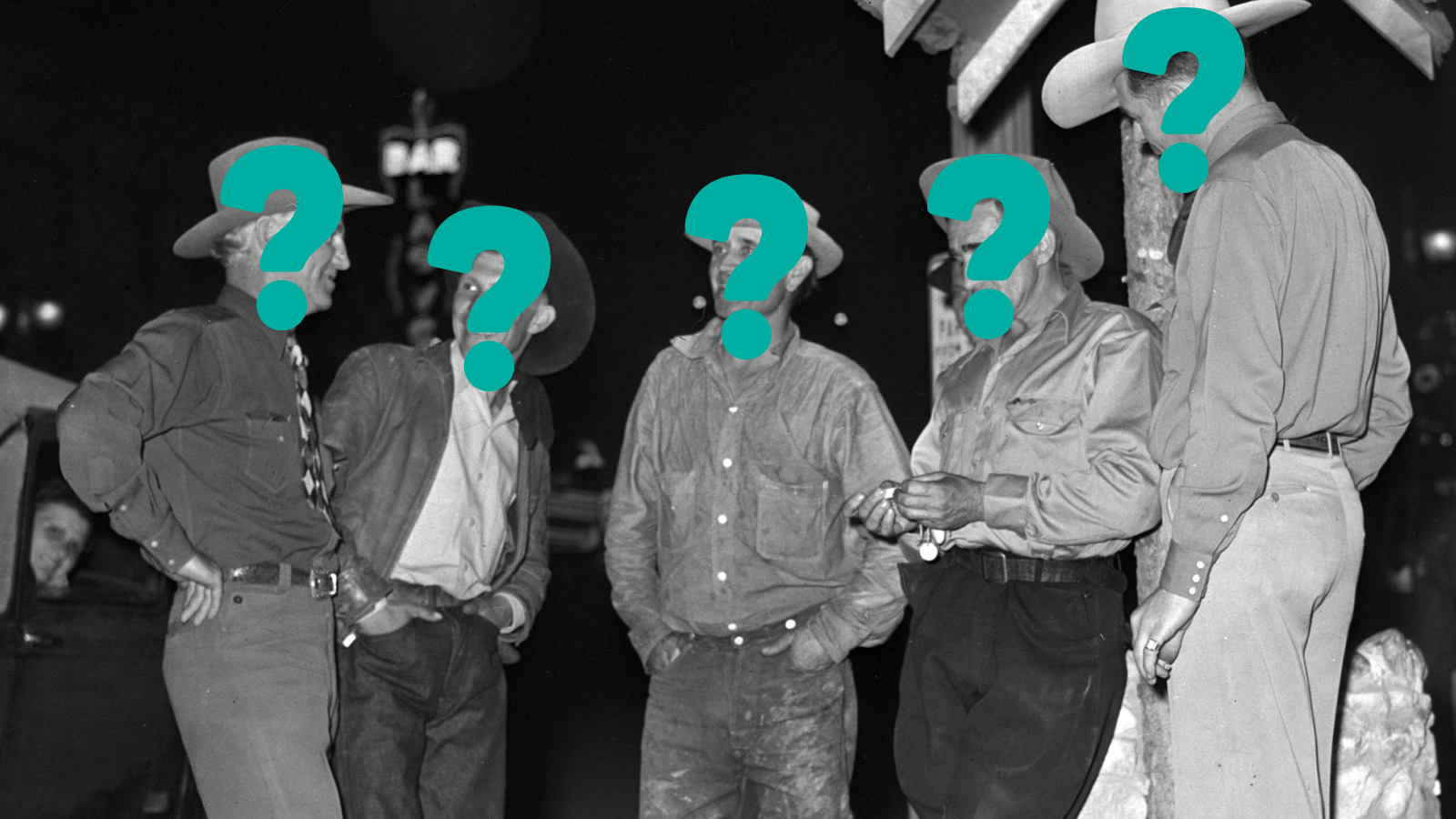
Unidentified photographs are one of the most common and persistent challenges facing community archives, libraries and local historical societies.
Boxes of images arrive with donations. Albums appear with no captions. Digital scans exist without dates, names or locations. Over time, staff change, volunteers move on, and the local knowledge that once explained those faces quietly disappears.
The result is familiar: collections rich in visual material, but poor in context.
Identifying the people in historical photographs is not just an administrative task. It is central to preserving meaning, enabling research, supporting genealogy, and ensuring that community history remains accurate and usable for future generations.
This article explores why identification is so difficult, how archives traditionally approach it, and how modern digital tools (including carefully applied facial recognition) can help without sacrificing ethics, consent or control. More broadly, it sits within the wider role that digital archives play in strengthening local identity and connection, something explored in more depth in our article on how digital archives strengthen communities.
Why unidentified photographs are such a challenge for community archives
Photographs are often donated separately from the information that gives them value.
A local resident may donate images decades after they were taken. A collection may be inherited by a society with no connection to its original compiler. In many cases, photographs pass through several hands before reaching an archive.
Common reasons identities are lost include:
No written captions or accession notes
Family members who knew the subjects have passed away
Collections merged from multiple sources
Physical albums separated from their original order
Early digitisation projects that prioritised scanning over metadata
Once names are lost, rediscovering them becomes time-consuming and resource-intensive, particularly for small organisations relying on volunteers.
In response to this challenge, some archives and heritage organisations adopt policies that prioritise accepting only material with clear identification or contextual information. The intention is understandable: limited storage capacity, cataloguing time, and volunteer resources mean organisations must make careful decisions about what they can realistically manage.
However, this approach also carries risks.
When unidentified photographs are declined or discarded, potentially valuable historical evidence can be lost permanently. Images that appear anonymous today may become identifiable in the future through community engagement, genealogy research, or connections with other collections. A photograph with no known names at the point of donation may still contain recognisable locations, events, social groups or visual details that gain meaning over time.
In many cases, the challenge is not whether unidentified material has value, but whether there is a sustainable system to hold it until knowledge emerges.
Digital archives increasingly help address this dilemma by allowing organisations to retain uncertain or partially identified material without overburdening physical storage or cataloguing workflows. Instead of choosing between acceptance and loss, archives can preserve images while leaving space for future identification and interpretation, particularly when collections are stored in a digital space communities can manage and control themselves rather than relying on external platforms.
Why identification matters more than it seems
It can be tempting to accept unidentified photographs as “nice to have” visuals rather than research assets. But unnamed faces limit the usefulness of a collection.
Without identification:
Genealogists cannot connect individuals to family trees
Researchers cannot confirm events or timelines
Schools, regiments and institutions lose alumni or membership links
Stories become anecdotal rather than verifiable
The same research work is repeated again and again
Identification transforms a photograph from an image into evidence.
Traditional methods archives use to identify people in photographs
Most archives already use a combination of well-established approaches.
These include:
Reviewing accession records and donor notes
Comparing images across multiple collections
Consulting census records, parish registers and directories
Engaging long-standing community members
Running identification days or exhibitions
Working with local genealogy groups
These methods are valuable and should not be replaced. They provide historical rigour and local insight that technology alone cannot replicate.
However, they also have limits.
Why traditional approaches struggle at scale
As collections grow, identification work becomes increasingly difficult to manage.
Challenges include:
Thousands of photographs with no obvious starting point
Volunteer fatigue from repeated manual comparisons
Knowledge held by individuals rather than systems
No way to track confirmed vs unconfirmed identifications
Limited visibility across separate collections
In many cases, archives know the answers may exist somewhere in the community, but have no efficient way to surface them.
This is where digital archives begin to change the picture.
How digital archives support better photo identification
Modern digital archive platforms are not just storage systems. When designed properly, they actively support identification work.
Key capabilities include:
Structured metadata fields for people, places and dates
Tagging systems that evolve over time
Linking individuals to multiple photographs
Searchable collections accessible beyond the archive walls
Controlled contribution from volunteers and researchers
By creating a single, searchable environment, digital archives reduce duplication of effort and make identification work cumulative rather than repetitive.
They also allow archives to move beyond simple preservation towards more active use of collections, for example, turning archives into stories and shareable content that encourages community engagement and participation over time.
Where tools like Google Lens fit, and where they don’t
Many archivists, volunteers and researchers experiment with visual search tools such as Google Lens when attempting to learn more about historical photographs. These tools can be useful in certain contexts.
They can help:
Recognise landmarks or buildings
Suggest visually similar images online
Identify objects, uniforms or locations
Provide starting points for further research
For quick exploratory work, they offer an accessible entry point.
However, tools designed for broad internet search are not built for archival workflows or heritage collections. Their usefulness for identifying individuals or building lasting historical knowledge is therefore limited.
Common constraints include:
No ability to connect images within a private collection
No structured metadata capture
No tracking of confirmed or unconfirmed identifications
No community contribution workflows
No consent or governance controls
No preservation of contextual knowledge over time
They are discovery tools, not archival systems.
Platforms designed specifically for heritage environments take a different approach. Rather than searching the public web, they focus on strengthening knowledge within a collection and its community, ensuring that context is preserved alongside images rather than lost over time.
Can facial recognition help identify people in historical photographs?
Facial recognition is often misunderstood in heritage contexts.
Used responsibly, it does not automatically name people or override human judgement. Instead, it performs one specific task: identifying visual similarities between faces across a collection.
This allows archives to:
Group likely matches together
See where the same person appears in multiple photographs
Surface potential connections that might otherwise be missed
It is a discovery tool, not a decision-maker.
For a broader look at how modern archive platforms support research in unexpected ways, see 10 things you didn’t know you could do with a digital archive.
What facial recognition can realistically do in an archive
In a community, heritage or library archive, facial recognition can:
Help cluster photographs of the same individual
Support researchers in tracing appearances across time
Reduce manual comparison workload
Highlight connections between collections
Assist volunteers and genealogists in focused research
Crucially, it works best when combined with existing metadata and community knowledge. In many projects, photographs once considered unidentified later become meaningful through new contributions, cross-collection matches, or emerging genealogical research. Technology can help surface those opportunities, but human insight remains essential, particularly when combined with community participation approaches such as capturing oral histories alongside photographs or local storytelling initiatives.
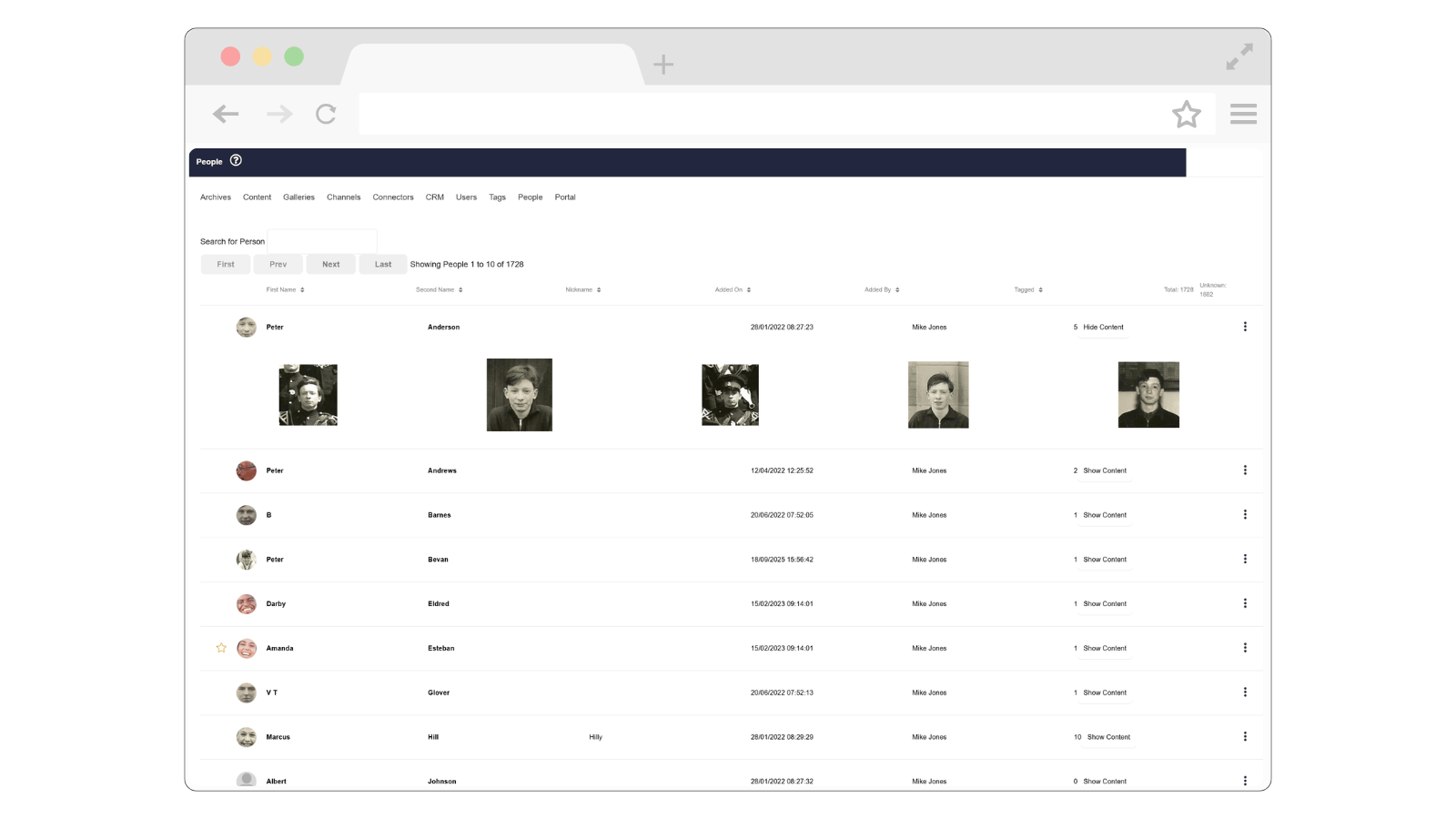
The YourArchive archive management interface allows you to group photographs of the same individual, add names and context, and track images that are still awaiting identification before information is shared publicly.
What facial recognition cannot (and should not) do
Equally important is clarity about limitations.
Facial recognition:
Cannot reliably identify unknown individuals by name
Should not make public identifications without confirmation
Is less accurate with damaged or very low-resolution images
Does not replace provenance or documentary research
Any ethical implementation must ensure that humans remain responsible for verification and interpretation.
Combining technology with community knowledge
The most effective identification projects blend digital tools with human insight.
A typical workflow might include:
Facial recognition groups similar faces
Archivists review suggested groupings
Community members or genealogy groups are invited to comment
Identifications are marked as confirmed, probable or unverified
Contributions are attributed and auditable
This approach respects expertise while making participation easier and more meaningful.
Community-driven initiatives, such as anniversaries or heritage projects, often provide ideal opportunities to gather this knowledge, as explored in community anniversary projects for local history.
Ethics, consent and control in photo identification
Identification work must always consider privacy and sensitivity.
Best practice includes:
Clear contributor consent
Transparent explanation of how tools are used
Moderation of public contributions
Options to restrict or remove sensitive content
Avoiding assumptions, especially for recent photographs
Responsible use builds trust, not just with contributors, but with funders, researchers and partner institutions.
Building a sustainable system, not a one-off project
Many archives attempt identification as a temporary initiative: an exhibition, a campaign, a special anniversary year.
While valuable, these efforts are far more effective when supported by a long-term system.
A sustainable approach means:
New information strengthens the archive permanently
Future researchers benefit from past work
Knowledge is retained even as people change
Collections remain active, not static
Digital archives enable this continuity, particularly when they are integrated into broader heritage strategies such as digital preservation planning for long-term collections or community storytelling initiatives.
Why identification strengthens community connection
Identification work does more than improve records. It invites people to participate in their shared history.
When communities are asked to help name faces:
People feel ownership over the archive
Memories are shared across generations
Genealogy groups and archives collaborate more closely
Trust in the institution grows
The archive becomes a living resource, not a closed repository.
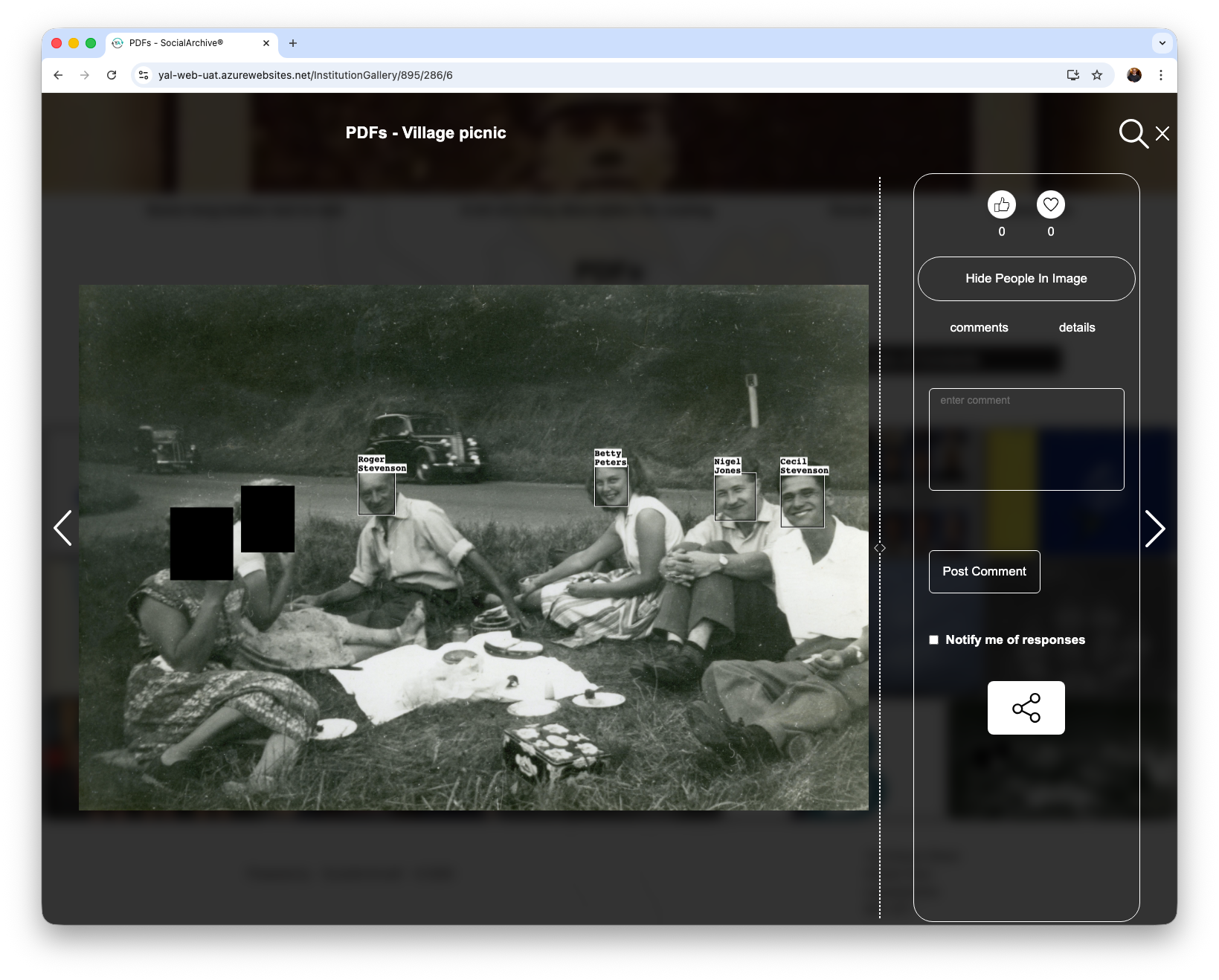
Screenshot of an image displayed within the public-facing YourArchive platform, where identified individuals are named and visitors can contribute comments or suggested identifications. Faces can be redacted to respect consent while preserving the original file, and access can be configured to suit each organisation, from fully open collections to restricted community-only environments.
Turning unidentified faces into lasting historical knowledge
Every unidentified photograph represents unfinished history.
By combining traditional research, community engagement and carefully applied digital tools, archives can transform collections that feel overwhelming into resources that grow richer over time.
Facial recognition, used ethically and transparently, is not about replacing expertise. It is about helping archivists, librarians and researchers focus their effort where it matters most.
Ultimately, identifying people in historical photographs ensures that community history is not just preserved, but understood, connected and passed on with accuracy and care.
Curious how this could work for your organisation?
If you’re exploring ways to organise historical photographs, involve your community in identification, or preserve knowledge alongside your collections, YourArchive offers a secure digital platform designed specifically for archives, libraries and heritage groups.
Get in touch, or arrange a short demonstration here to find out more.
FAQs:
Why do so many historical photographs in archives have unidentified people?
Photographs often lose context over time because captions were never recorded, family knowledge fades, collections are merged from multiple sources, or materials are donated long after they were created. Without a structured system to capture names and relationships, identities can quickly become disconnected from images.
Can facial recognition identify people in historical photographs?
Facial recognition can help group similar faces across images, making it easier for archivists and researchers to spot potential matches. However, it cannot reliably identify individuals by name on its own. Human knowledge, community input and documentary research remain essential for confirmation.
Is it worth keeping unidentified photographs in an archive?
Yes. Photographs that appear unidentified today may become meaningful later through community engagement, genealogy research or connections with other collections. Preserving images allows future identification opportunities that would otherwise be lost if materials were discarded.
Can tools like Google Lens help identify historical photographs?
Visual search tools such as Google Lens can help recognise locations, objects or similar images online, which may support research. However, they are not designed to manage archival collections, capture metadata or preserve contextual knowledge over time. Archives typically need dedicated systems to record and verify identifications.
How can community archives involve the public in identifying photographs?
Many organisations invite participation through identification events, online contributions, genealogy partnerships and storytelling projects. Digital archive platforms can support this by allowing controlled contributions, tracking confirmations and preserving community knowledge alongside images.
Other articles that may be of interest: